Launceston role in making the first Holden car

In November 1946 it was announced that General Motors-Holden’s Ltd had reached an agreement to take over the Tool Annexe at the Launceston Railway Workshops to produce tooling for its proposed Australian-made car.

GMH had responded to a request from the federal government in 1945 to make a mass-produced Australian car. Up to this time most cars sold in Australia were either fully imported or assembled from components from overseas car makers.

The Examiner of Wednesday, November 20, 1946, reported that production details had been discussed between the GMH technical superintendent (Mr W. G. Davis). the Secretary for Transport (Mr A. K. Reid) and the administrative officer at the annexe (Mr P. H. Welch).

“Mr Davis will remain in Launceston as technical superintendent of production. He has had wide experience in engine manufacture … and recently joined General Motors as assistant chief inspector of mechanical operations.”

The Examiner said that since the end of World War II the Tool Annexe has been conducted by the Tasmanian Transport Commission and has been turning out tractor parts of such precision that only one-half of one per cent were rejected.

Mr Davis said various types of punches, dies, trimming tools, component parts and very large assembly jigs for sub-assembly and final assembly of panel would be made.

“The modern and very valuable equipment in the annexe and the high standard of workmanship attracted General Motors, and work which began in Launceston this week is one of the first practical steps in the actual production of Australian cars.”

Details of Australia’s first locally made car slowly emerged as production facilities were set up around the country.

At Woodville in South Australia the bodies and metal pressings for the new car were being produced at a £1,744,000 factory and at Fishermen’s Bend in Melbourne a 12,000 square metre plant was built for the manufacture of the engine, transmission and other basic car components.

GMH said that when the car was in full production it would provide direct employment for about 9000 Australians and indirect employment for thousands more in businesses supplying raw materials or specialised components for the new car.

It was announced that the new car would be simply called the Holden and would be priced at £733, which was about two years’ wages for an average worker at the time.

By the time Prime Minister Ben Chifley unveiled the first Holden 48-215 (later known as the FX) on November 29, 1948, it was announced that 18,000 people had already paid a deposit.

The first Holden car to come to Tasmania was unveiled by the Premier Robert Cosgrove in Hobart the following day. He said the development of the Holden marked Australia’s “growing up as a nation.”

Australians embraced the first locally mass-produced car and over the next five years 120,402 Holden vehicles were manufactured and sold.

Image — TOP: Holden cars roll off the Fishermen’s Bend production line factory. State Library of Victoria, public domain image.

Written for the Launceston Historical Society and published in The Sunday Examiner, on 29 October 2023.
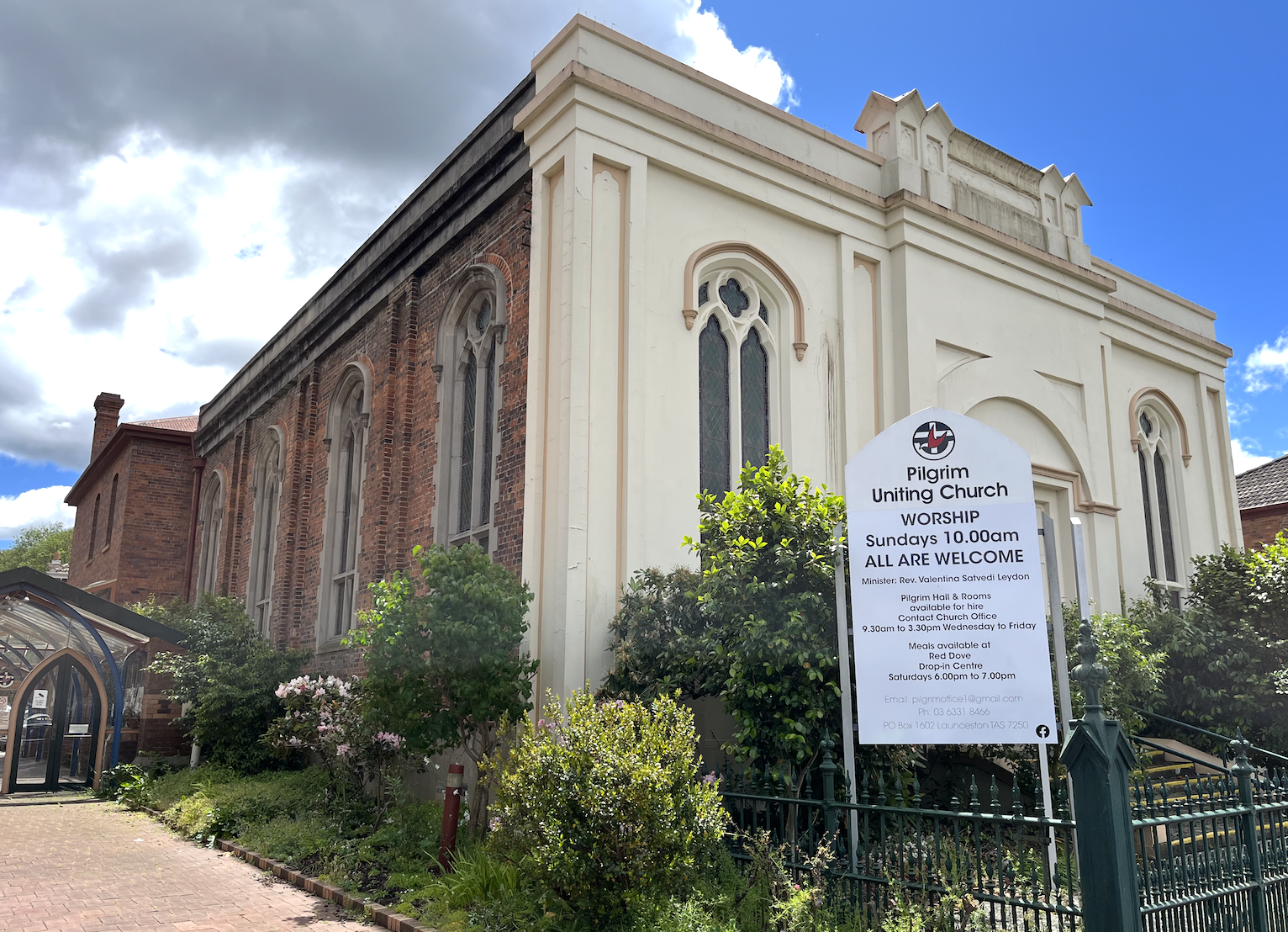
The historic Wesleyan Chapel in Paterson Street

Launceston’s second church, near the corner of Cameron and George streets, held its first service on Sunday 4 March 1827, in a chapel built by the Wesleyan Missionary Society.

The Wesleyans were only a little over a year behind the Church of England in erecting a place of worship in Launceston with St John’s Church holding its first Devine Service on 16 December 1825.

That first Wesleyan chapel no longer exists but its successor in Paterson Street, now known as Pilgrim Hall, was completed in 1835 and has survived for 188 years. It was recently announced the building was to be sold.

The Tasmanian and Port Dalrymple Advertiser, on Wednesday 6 April 1825,reported that the Wesleyan Missionary Rev. John Hutchinson had just arrived in Launceston from Sydney to minister to the free and convict residents of Port Dalrymple.

The only other minister in northern Van Diemen’s Land at the time was Church of England chaplain John Youl who had begun his ministry in 1819.

As the church of the British Empire, the Church of England had all its costs covered by the colonial government that initially declined to provide similar support to other denominations.

In 1825, Launceston had a population of about 1,200, half or whom were convicts, and Rev. Youl was overseeing the construction of Launceston’s first proper church, St John’s.

Rev. Hutchinson conducted his first service two weeks after his arrival in a house in Cameron Street, opposite John Fawkner’s Cornwall House (later the Cornwall Hotel).

By February 1826, shortly after the first Church of England service was held in St John’s, it was reported that between £200 and £300 had been pledged by Launceston residents for the construction of a Wesleyan chapel in the town.

Rev. Hutchinson however was ordered to leave Launceston and in March 1826 he departed for the Polynesian kingdom of Tonga to undertake missionary work.

His removal slowed work on the chapel and in July 1826 the treasurer of the building committee, brewer William Barnes, requested residents to pay the money they had pledged “for the erection of this place for public worship” as funds had been “entirely exhausted.”

It wasn’t until Sunday 4 March 1827 that a lay preacher officiated at the first Divine Service in the new Wesleyan chapel near the corner of Cameron and George streets (near where the Anglican Holy Trinity Church now stands).

A new minister for the chapel could not be found and there was outrage when it was learnt in 1829 that the Wesleyans were planning to sell their Launceston chapel. Despite the protests the government bought the property and the chapel became a school and the parsonage was turned into a government store.

The proceeds of the sale were held by John Fawkner who later passed the money on to the Scotch National Church for the erection of their first church in Charles Street in 1831.

Rev. John Manton, a Wesleyan missionary who had been ministering at the Macquarie Harbour and Port Arthur convict stations since 1831, was ordered to Launceston in 1834 and the following year Lieutenant-Governor George Arthur granted land in Paterson Street for a new chapel.

The foundation stone was laid on 20 April 1835, and the Launceston Advertiser reported that the site for the chapel was on open space fronting on Paterson Street.

“The builders are to be Messrs Weir and Ferguson, of this Town, whose tender was accepted by the Committee. The plan, drawn by Mr S. Jackson, we have before noticed, as of one of the prettiest buildings we have known designed in Van Diemen’s Land.”

On Christmas Day 1835 (a Friday), Rev. Manton preached at the first Divine Service in the chapel and in 1839 a parsonage was built next door.

With a growing congregation more land was obtained to the west of the chapel and the foundation stone for the more imposing Paterson Street Methodist Church was laid on 18 September 1866.  The church was opened for services on 21 February 1868.