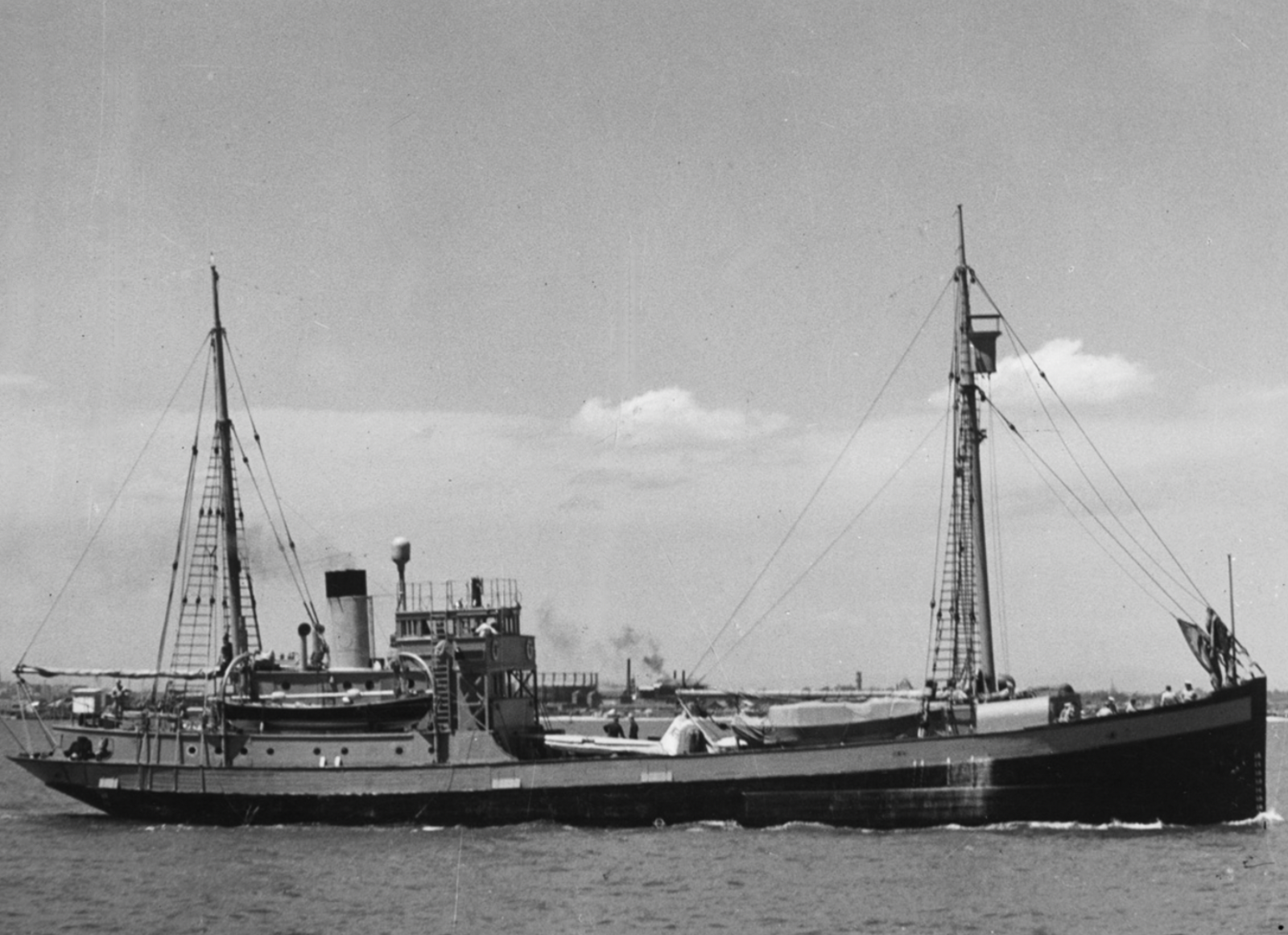
In 1947 a Norwegian-built cargo ship and a former Royal Navy tank landing craft set sail on the first Australian National Antarctic Research Expedition. They were an odd couple; the ship had become HMAS Wyatt Earp and the landing craft was simply known as HMLST 3501.
After their pioneering voyages to Antarctica one of the ships would carry potatoes from North-West Tasmania to the mainland and end its career wrecked on the Queensland coast and the other would be scrapped.
As MV Fanefjord, the 41m timber ship Wyatt Earp was bought by American explorer and Arctic aviator Lincoln Ellsworth in 1919. The ship had been refitted inside and its hull strengthened with steel plate. Ellsworth renamed the ship Wyatt Earp in honour of the marshal of Dodge City and Tombstone, in Arizona.
The ship made several trips to Antarctica under Ellsworth’s ownership and famous Australian explorers Sir Douglas Mawson and Sir Hubert Wilkins were part of his expeditions. Ellsworth had flown over the Arctic Ocean in 1929 in a balloon with Norwegian explorer Roald Amundsen and was successful in completing the first trans-Antarctic flight in 1935.
In 1939 the Australian government bought the Wyatt Earp and renamed it HMAS Wongala, an Aboriginal word meaning boomerang. Its war service was spent mostly as a coastal patrol vessel in South Australia.
After the war the ship was refurbished and reverted to Wyatt Earp, with the HMAS prefix, for Australia’s first Antarctic expeditions in 1947-1948 to establish research stations at Macquarie and Heard islands.
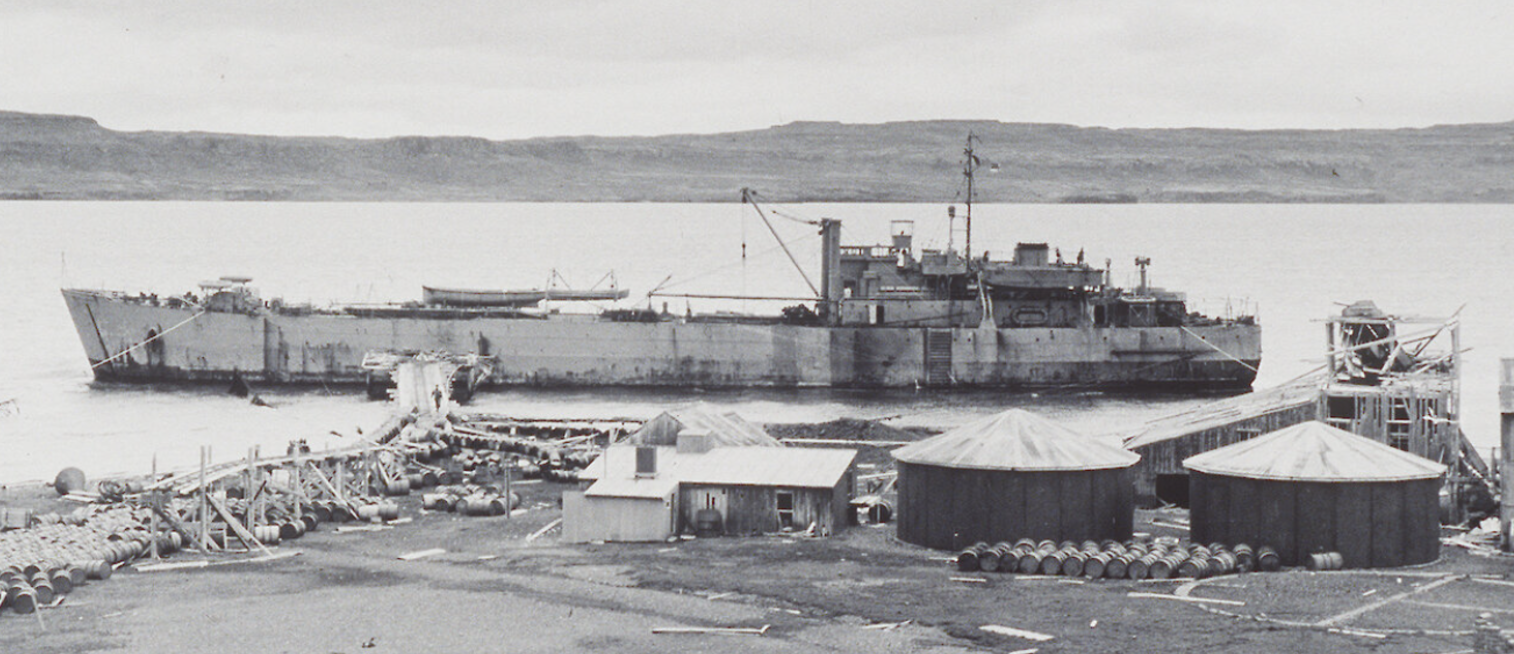
The HMLST 3501 (Her Majesty’s Landing Ship Tank) was 105m long, twice the length of Wyatt Earp, and had been built in Canada in 1943 for the Royal Navy and saw service in the Mediterranean and Atlantic during World War II before being sold to the RAN.
The ships left separately for the Southern Ocean with HMLST 3501, under the command of Lieutenant-Commander George Dixon, departing from Fremantle in October 1947 for Heard Island, halfway between Australia and Africa. HMAS Wyatt Earp, under the command of Captain Karl Oom, departed Hobart in December for Commonwealth Bay in Antarctica.
HMLST 3501 arrived at Heard Island at the end of December where navy personnel landed supplies, erected prefabricated buildings and installed equipment for eight scientists and support staff to spend a year undertaking meteorological and other research.
The ship then made a reconnaissance of ice conditions in the far south and headed for Macquarie Island, 5,250km to the east and 1,450km south-east of Hobart, to establish the other station where seven scientists and support staff would spend a year.
Both ships carried seaplanes, crewed by RAAF personnel, to make reconnaissance flights over Antarctica. HMLST 3501 had been painted bright yellow to help the seaplane crew find the ship after their flights.
Lieutenant-Commander J. H. T. (Jack) Burgess (the author’s uncle), whose family lived in Launceston, was the executive officer on HMLST 3501.
After HMAS Wyatt Earp left Hobart in December 1947 for Antarctica, 2,700km south of Tasmania, bad weather and mechanical problems forced it back to Melbourne for repairs. It was reported that everyone on board had been violently seasick.
The ship had to be put into the Williamstown dry dock and wasn’t able to continue its voyage south until early February 1948. Despite more mechanical problems, bad weather and heavy ice, HMAS Wyatt Earp finally arrived off Antarctica on 19 February.
However, it could not close the Antarctic mainland due to pack ice and more bad weather. By March plans to reach land were abandoned and the ship headed for Macquarie Island where HMLST 3501 had already unloaded its cargo of stores, prefabricated buildings and scientific equipment.
Both ships then returned to Australia. After the voyage the master of HMAS Wyatt Earp, Captain Oom, reported that the ship was too old, too slow and too small for further Antarctic expeditions.
The Antarctic Division of the Department of External Affairs was created in May 1948 to administer and coordinate Australia’s future expeditions and on 30 June HMAS Wyatt Earp was paid off in Melbourne.
Although reported as an uncomfortable ship by its crew, HMLST 3501 continued as an Antarctic supply vessel. It was given a more dignified name in December 1948 when it was renamed HMAS Labuan, in honour of World War II amphibious landings on the Malaysian island.
HMAS Labuan made five more supply voyages to the Heard and Macquarie island research stations before being badly damaged near Heard Island in 1951. Labuan was paid off by the navy in September 1951 and sold for scrap in 1955.
HMAS Wyatt Earp was bought by the Arga Shipping Company in Victoria in 1951 and renamed Wongala, one of its former names. It was put to work carrying cargo between Tasmania and the mainland.
There was another ownership change in 1956 when the ship was acquired by the Ulvertstone Shipping Company. Re-named again, this time MV Natone for the potato growing district of Natone near Ulverstone. The ship traded in Tasmania for 18 months before moving to Queensland where it was wrecked in January 1959 near Rainbow Beach.
A camping area on the Inskip Peninsula is named in honour of MV Natone, the former Australian navy ship and Antarctic exploration vessel, that had carried the name of a hero of America’s Wild West!
(Corrections made on 20 January 2025 thanks to Trish Burgess (no relation) the author of WYATT EARP, The Little Ship With Many Names, Connor Court Publishing)
Images — TOP: HMAS Wyatt Earp. BOTTOM: Her Majesty’s Landing Ship Tank 3501 at Heard Island in 1948.
 julianburgess.com.au