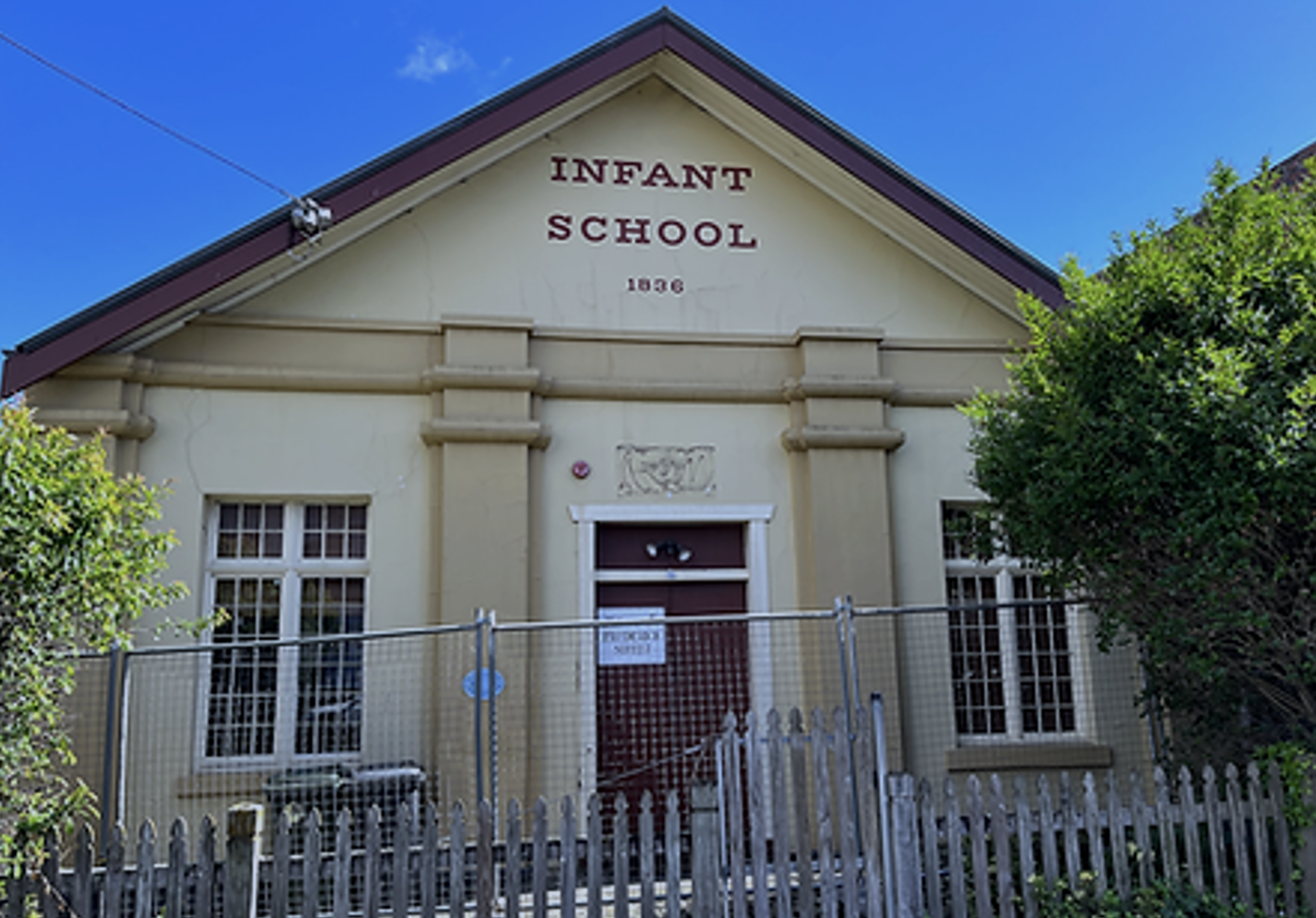
The historic Launceston Infant School building in Frederick Street will soon be restored and re-purposed as the Launceston History Centre and make thousands of important local books, documents and research materials available for public access.
The main building dates from 1836 and was Launceston’s first infant school. It has given great service over the past 187 years, serving as a school, church, kindergarten and childcare centre.
The property is owned by the City of Launceston Council which was considering selling it but following community pressure councillors voted to keep in public hands.
After a lengthy Expression of Interest process the Launceston History Centre was granted a long-term lease which was signed in January 2025.
Major structural remediation will be undertaken following the signing of the lease with new toilets and a climate controlled storage facility added to the site. The original infant school building will not be altered.
The Launceston History Centre was formed in May 2022 by the Friends of the Launceston Mechanics’ Institute, Tasmanian Family History Society (Launceston Branch) and the Launceston Historical Society.
It became an incorporated body under the Tasmanian Associations Incorporations Act on 20 June 2022.
The infant school is a typical story of early Launcestonians having to build their own public institutions.
Tenders were called for its construction in April 1835 by a group of community-minded citizens and followed the establishment of an infant school in Hobart in 1832.
Public subscriptions, a government loan of £250 and the promise of £50 a year to pay for a teacher was obtained to get the Launceston school underway.
Prominent among the founding members of the Launceston Infant School committee were businessmen John Ward Gleadow, Phillip Oakden, Lewis Gillies and Henry Reed, solicitor Henry Jennings and Reverends Henry Dowling and William Browne.
They announced the school would be open to all children between the ages of two and seven years, with the Holy Scriptures being the basis of all instruction.
It served as a school, church and meeting room for the next 50 years.
The Tasmanian newspaper of Saturday 7 January 1888 described the infant school as one of the earliest public buildings in Launceston:
In those early days it was not a difficult matter to obtain from the Government a grant of land for public purposes, and the need for an Infant School in Launceston having been felt several gentlemen applied for a site for such an institution.
The minutes of their proceedings show that on 9th January 1835, the committee wrote to George Frankland, Esq., Surveyor-General, asking him to point out the piece of land set apart by the Government for an Infant School.
Shortly afterwards, but for what reason does not appear, unless that the site understood to be reserved by the Government was deemed too far from the centre of the town, Mr Gleadow and Mr Reed were empowered by the committee to select and purchase a piece of land and procure specifications for a building.
The land offered by the government turned out to be a quarter of an acre fronting on Tamar Street, at the end of Cameron Street, near the entrance to today’s City Park but it was thought at the time to be too remote.
On 27 January 1835, John Gleadow and Henry Reed reported that they had bought a block of land in Frederick Street, from John Thompson for one hundred and twenty guineas, and had accepted builder John Anderson Brown’s tender of £564 to construct the school.
Work was expected to start immediately with the government providing a gang of convicts to dig the foundations and quarry the stone required. Bricks that could be spared from government works were to be provided.
Progress was slow and in the meantime the committee announced they had obtained temporary premises at the southern end of Charles Street (on the corner of Balfour Street) and recruited an infant school master and mistress, Mr and Mrs Lilly, from NSW.
On 16 June 1835, eleven children were enrolled but this soon increased to about 60 and no more children could be accommodated until the new school house in Frederick Street was completed.
Subscribers and other interested citizens were invited to the new Frederick Street Infant School on 3 March 1836 to celebrate its imminent completion.
When the annual meeting of the Launceston Infant School Society was held on Wednesday 15 February 1837 there were 100 students on the books.
Over the next 30 years the building was also used for church services, at first by Rev. Henry Dowling, and a meeting place for organisations like the Launceston Temperance Society.
However, in 1860 the building was leased to the government “for a peppercorn rent” and became a state school, a role it filled until the construction of a new school at the Sandhill in 1885.
The last surviving trustee of the Launceston Infant School Society, the Reverend Charles Price, then offered ownership of the school to the Launceston Municipal Council. The transfer was completed at the end of 1887.
The Tasmanian of Saturday 7 January 1888 noted that the property was very valuable and would become more valuable as time passed, “and we may express a hope that it will never be alienated or abused.”
The council marked their appreciation of the Rev. Price’s action by passing a formal vote of thanks, and ordering it to be recorded in the minutes.
Under municipal council ownership the historic building was used as a kindergarten for many years and more recently as a childcare centre.
An engineers’ report in 2023 revealed a number of structural faults in the building and cracks and peeling paint on the exterior had become clearly visible.
The City of Launceston Council will oversee the structural remediation and restoration of the building before the Launceston History Centre take up their lease.

The copyright for the words and images in this article are held by Julian Burgess.
 julianburgess.com.au