St John’s Church is an important part of Launceston’s history. In 1824 the northern headquarters of Van Diemen’s Land was relocated from George Town to the head of the Tamar River. In the same year the foundation stone was laid for St John’s Church in Launceston.
In 1825 construction of St John’s Church was completed and the first divine service held. St John’s Church is the oldest public building in the city of Launceston and the oldest surviving Anglican church in Tasmania.
The church has reflected the progress of Launceston over 200 years and there are numerous remarkable events and firsts in the story of St John’s.
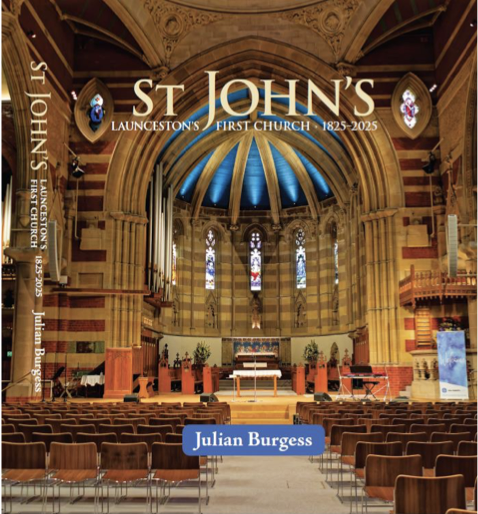
The story of the church is told in a new book, St John’s – Launceston’s First Church 1825-2025, launched on 29 April 2025. The book is part of bicentenary celebrations for the church.
The St John’s Church story starts with courageous Reverend John Youl who was the first ordained minister in northern Van Diemen’s Land. He arrived in 1819 and oversaw the construction of the first iteration of St John’s.
The foundation stone was laid by newly arrived Lieutenant-Governor George Arthur on 28 December 1824. Construction began in early 1825.
The first funeral service in the church was held on Wednesday 24 August 1825, before the building had even been completed.
Charlotte Balfour, the 33-year-old wife of Launceston Commandant William Balfour, died in childbirth and was interred inside the walls of the unfinished church.
Her resting place, marked by a plaque on the original southern wall, remained largely forgotten until major building works in 1911.
It was uncovered again in 1938 when a new floor was installed and again last year when electrical work was undertaken. Charlotte Balfour was the first and only person buried at St John’s Church.
The first Divine Service was held in St John’s on Friday 16 December 1825.
In 1829 a clock was installed in St John’s Church tower which became Launceston’s first town clock. The clock in St John’s tower served in that role for more than 80 years. In 1837 the first stained-glass window was installed, believed to be the first in a church in Tasmania.
In 1846 the Launceston Church Grammar School opened next door, with St John’s used for regular school chapel services. The Grammar School is said to be Australia’s oldest continuously operating school.
When St John’s second rector Revd Dr William Browne retired in 1868, after 40 years in the role, he said his Parish Register recorded that during his Ministry he had performed 1,834 marriages, 4,153 baptisms and 2,231 burials.
In 1893 the church leased the former Queens Head Hotel in Wellington Street and converted it into the first St John’s Mission House.
It offered support and accommodation for Launceston’s poor and homeless under the caring management of Sister Charlotte Shoobridge who was ordained as Tasmania’s first deaconess by Bishop Henry Montgomery in St John’s Church on Saturday, 13 October 1894,
In 1902, Bishop Mercer said that should the Diocese of Tasmania ever be divided, St John’s, as the Mother Church of the North, would naturally become a cathedral.
In 1912, following the completion of a major extension of the church, St John’s was being referred to as “the Cathedral of the North”.
The church was full when St John’s held its first Anzac Day service on Tuesday 25 April 1916. There was a congregation of more that 1,000 for the National Day of Prayer in St John’s on Sunday 26 May 1940 calling for peace in Europe. The Governor, Sir Ernest Clark, was in attendance.
The church was again full for the special service on Tuesday 2 June 1953 to mark the coronation of Queen Elizabeth II.
In 1955 parish records noted 117 marriages and 195 baptisms in St John’s. It was said that more marriages were solemnised at St John’s than any other church in Launceston and the same could be said for baptisms.
In 1997 former Prime Minister Gough Whitlam delivered the eulogy at the funeral of his former deputy Lance Barnard, the long-serving Federal Member for Bass.
The Brindley organ in St John’s, first installed in 1862, has been described as the finest in the nation. In 2007, the long-held goal to complete the rebuilding of the organ, as designed by organist George Hopkins in the early 1900s, was completed.
For 200 years St John’s Church has been a place of worship for generations of northern Tasmanians and a place of celebration, mourning and contemplation for many others.
Its imposing presence on the edge of the business district has aways been a reassuring and comforting sight for Launcestonians, both parishioners and other citizens.
St John’s Church has only had 20 rectors since 1825. The incumbent in 2025 is The Venerable James W. Hornby, B.ForestSc, M.Div.
(St John’s – Launceston’s First Church 1825-2025 was written by Julian Burgess and produced by Forty South Publishing for the All Saints Network as part of the parish’s bicentenary celebrations during 2025. The book is available from St John’s Church office, 157 St John’s Street, Launceston, Tasmania, Phone (03) 6331 4896.)
 julianburgess.com.au