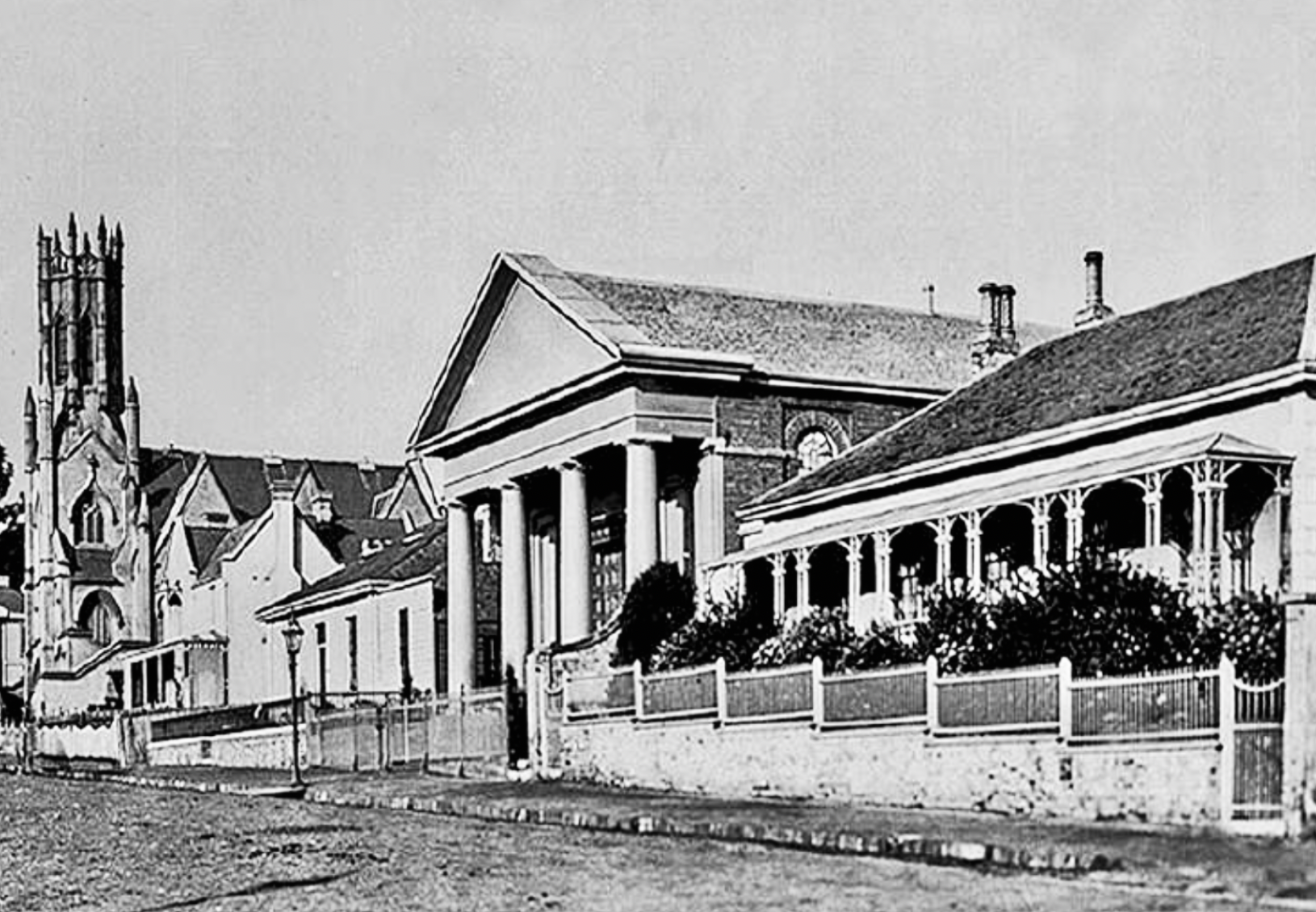
Milton Hall, sold in 2022 by the Baptist Union of Tasmania, is a hugely important place in the history of Launceston.
It was built in 1842 and paid for by supporters of the Independent pastor Rev. John West as the St John Square Congregational Chapel.
John West biographer Patricia Ratcliff wrote that he was “arguably the most influential of the middle class dissenters, a person of colossal intellect, a dynamic orator with a mellifluous voice.”
The Rev. West arrived in Launceston in 1839 and initially held services in an infant schoolroom in Frederick St, between Wellington and Charles streets.
By 1841 his congregation had grown so much that a proper church was needed.
A block of land was bought further up Frederick Street and money was pledged to erect a new chapel. The prominent Baptist minister Henry Dowling laid the foundation stone on Thursday, September 2, 1841.
It took builder George Gould nearly a year to complete the Doric Temple style chapel with the dedication service held on Friday, August 12, 1842.
The first services were held on the following Sunday with sermons by Rev. Dowling, Rev. Joseph Beazley, of the Kempton Congregational Church, and Rev. William Garrett, of the Presbyterian Church.
John West and members of his congregation established a number of important community and charitable institutions in Launceston.
They include the Mechanics’ Institute (predecessor to the Launceston Library and the Queen Victoria Museum and Art Gallery), the City Mission and a general cemetery.
He also supported the establishment of business organisations like the Cornwall Insurance Company and The Examiner newspaper.
John West wrote the leading article in the first edition of The Examiner attacking convict transportation and its detrimental effect on building a respectable, sound and prosperous society.
From 1842 to 1854 his editorials championed social reforms.
In 1849 John West designed a flag for the Anti-Transportation League that was unveiled at a national meeting in Melbourne. It is considered to be the model of the Australian flag
He published his History of Tasmania, printed at The Examiner, in 1852 and it is still widely quoted and considered an important source of information on Tasmania’s first 50 years.
His series of essays entitled Union of the Colonies, written in Launceston in 1854, outlined his vision for the federation of the Australian colonies.
Convict transportation to Tasmania had ended when John West resigned as pastor of the St John’s Square Chapel in 1854 to accept the position of editor of the Sydney Morning Herald.
He died in 1877 and it is quite remarkable that so many of the institutions he helped establish continue to benefit Launceston.
Image — TOP: Frederick Street in 1866 shows Chalmers Church, John West’s Congregational Chapel (Milton Hall) and schoolhouse. Picture courtesy State Library of Victoria.
 julianburgess.com.au